 blog
What to Look for in Janitors: 7 Key Hiring Criteria
Table of Contents
- Start With Core Competencies and Work Ethic
- Janitorial Service Interview Questions That Reveal Real Skill
- Janitor Background Check Requirements and Security Protocols
- Commercial Cleaning Performance Standards to Measure Against
- Safety Knowledge and Chemical Handling
- Cultural Fit, Communication, and Retention
- Frequently Asked Questions
Last Updated: September 20, 2026
Start With Core Competencies and Work Ethic
Knowing what to look for in janitors starts with two traits you cannot teach: reliability and care. Skills can be trained; work ethic cannot.
Reliability and Punctuality
Reliability is the single best predictor of janitorial success: a janitor who shows up on time daily beats a more skilled worker who calls out twice a month.
Watch for these signals during hiring:
- A steady work history with gaps explained clearly
- A valid driver's license and reliable transportation
- Willingness to work early mornings, nights, or weekends
- References who confirm attendance, not just attitude
Attention to Detail in Surface Sanitation and Floor Care
Surface sanitation and floor care reveal whether a janitor notices things. Ask candidates to describe their routine for restrooms, lobbies, and high-touch areas.
Strong candidates mention specifics:
- Which disinfectants they use and why
- How they handle floor care on different surfaces
- Where they check for missed spots before leaving
Janitorial Service Interview Questions That Reveal Real Skill
The best janitorial service interview questions test judgment, not memorization. Anyone can list tasks. Fewer can explain what they would do when something goes wrong.

Scenario-Based Questions for Problem Solving
Scenario questions show how a janitor thinks under pressure:
- "You find a clogged toilet ten minutes before a client tour. What do you do first?"
- "A tenant complains that their office was missed. How do you respond?"
- "You notice a small water leak near an outlet. What are your next steps?"
- "You are running behind on your route. How do you decide what to skip?"
Listen for safety first, then communication. A janitor who calls a supervisor about a leak beats one who ignores it.
Janitor Background Check Requirements and Security Protocols
Janitor background check requirements vary by employer and state, but most commercial facilities run at least a criminal history check before hiring. Janitors work alone, after hours, with keys, alarm codes, and access to tenant spaces, so screening is non-negotiable, and it must be run correctly, not just run.
The Legal Framework You Are Working Inside
If you use a third-party screening company, your process is governed by the Fair Credit Reporting Act (FCRA). The FTC guidance on background checks lays out the sequence employers are expected to follow:
- Disclosure and authorization. Give the candidate a clear, standalone written disclosure that a consumer report may be obtained, and get their written authorization. Do not bury this in the application.
- Pre-adverse action notice. If you are inclined to reject based on the report, send the candidate a copy of the report and a summary of their FCRA rights before you decide.
- Reasonable waiting period. Give the candidate a real chance to dispute inaccurate information, commonly about five business days, though the statute does not set a fixed number.
- Adverse action notice. If you proceed with rejection, send a notice with the screening company's contact information and a statement of the candidate's rights.
What to Screen For
Standard screening steps for janitorial roles include:
- Identity verification and work authorization (Form I-9)
- Criminal background check at the county and state level, plus a national database search
- Sex offender registry check where the role involves access to schools, healthcare, or childcare facilities
- Reference calls with past supervisors
- Drug testing where the employer or the client requires it
- Motor vehicle record check if the janitor drives a company vehicle or operates a floor machine on a route
State and Local Limits You Cannot Ignore
Background check rules are not uniform. Patterns worth knowing:
- Ban-the-box laws. Many states and cities restrict when you can ask about criminal history, often not until after a conditional offer. Check your state's rules before you put a criminal history question on the application.
- Seven-year lookback limits. Some states cap how far back a consumer reporting agency can report certain convictions.
- Salary and arrest-record rules. Several states prohibit reporting non-conviction arrests, and some restrict using salary history in hiring.
- Healthcare and education clients. Facilities serving vulnerable populations often require fingerprint-based state or FBI checks in addition to the standard package.
Building Security Onboarding
Screening is only half the job; the other half is day one. Walk new janitors through:
- Alarm codes and arming/disarming procedures, with a written record of who holds each code
- Key and keycard control, including a signed key receipt and a log of issued credentials
- After-hours contact tree and escalation steps
- Visitor and vendor sign-in expectations
- Incident reporting for anything unusual, doors found unlocked, unfamiliar people on site, damaged fixtures
Retention Signals Hidden in the Screening File
Here is the angle most hiring guides miss: your screening and reference process is also your best retention forecast. A candidate with three janitorial jobs in eighteen months is not automatically disqualified, but ask why. Look for:
- Tenure that matches the story, a two-year stint at a school district reads differently than three six-month stints at staffing agencies
- References who can speak to how the person left, not just how they performed
- Gaps that are explained the same way twice, to two different people
- Willingness to name a supervisor who can vouch for them
Commercial Cleaning Performance Standards to Measure Against
Commercial cleaning performance standards turn "looks clean" into something measurable. Without written standards, every inspection becomes an argument.
Set standards for each area of the building:
- Restrooms: disinfected daily, restocked, no odors
- Floors: swept, mopped, buffed on schedule
- Lobby and entryways: spotless glass, clean mats
- Waste disposal: emptied daily, bins wiped
Building a Service Level Agreement
A service level agreement spells out what gets cleaned, how often, and to what standard, protecting both sides.
A simple SLA should cover:
- Scope of work by area and frequency
- Response times for spills and complaints
- Inspection schedule and scoring method
- What happens when a standard is missed
Safety Knowledge and Chemical Handling
Chemical safety knowledge protects your staff, your building, and your liability exposure. Janitors handle disinfectants, floor strippers, glass cleaners, and drain treatments, and mixing the wrong two can create toxic gas in a closed restroom, this is where a weak hire becomes a workers' compensation claim.
The Regulatory Baseline
OSHA's Hazard Communication Standard (29 CFR 1910.1200) requires employers to train workers on every hazardous chemical they may be exposed to, maintain safety data sheets, and ensure containers are labeled. The OSHA Hazard Communication Standard overview is the reference document most facility managers keep on hand. The practical takeaway: you cannot hand a new janitor a bottle and a mop and call it onboarding.
What to Test Candidates On
A janitor who has been properly trained will recognize these concepts without prompting:
- Safety data sheets (SDS). Formerly called MSDS, these are now standardized under the Globally Harmonized System (GHS). Ask candidates where SDS binders or digital SDS access lives at their last job. A blank look is a red flag.
- GHS pictograms. The red-bordered diamond symbols for flammables, corrosives, acute toxicity, and health hazards. Ask a candidate to name two.
- PPE. Gloves, eye protection, and, for tasks like stripping floors or handling concentrated chemicals, respirators or aprons. Ask which tasks they would not do without gloves.
- Never-mix rules. Bleach with ammonia produces chloramine gas. Bleach with acid-based toilet bowl cleaner produces chlorine gas. Both send people to the emergency room. Ask the candidate to name a combination they would never mix.
- Dilution control. Concentrated chemicals must be diluted to the manufacturer's ratio. Over-concentrating wastes product and can damage surfaces; under-concentrating leaves pathogens behind. Ask how they measure.
- Ventilation. Restrooms, closets, and small offices need airflow when chemicals are in use. Ask how they handle a small space with no window.
- Storage and labeling. Secondary spray bottles must be labeled. Chemicals stay in their original or properly labeled containers, never in an unmarked water bottle.
The Janitorial Cart as a Safety System
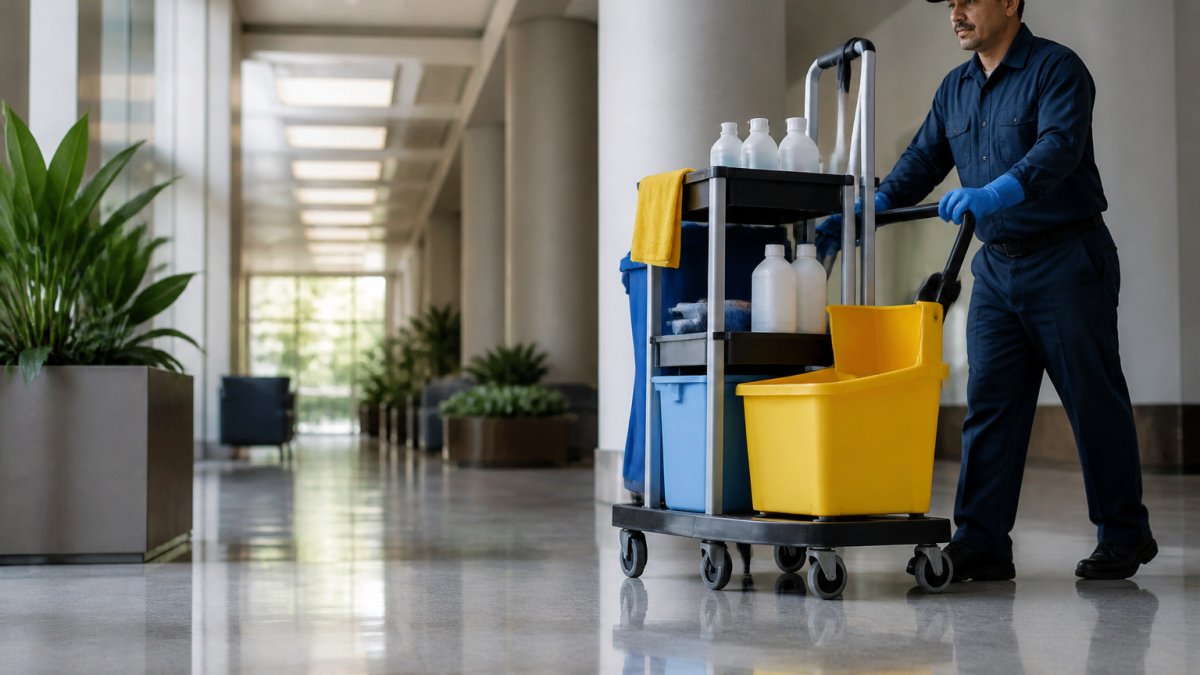
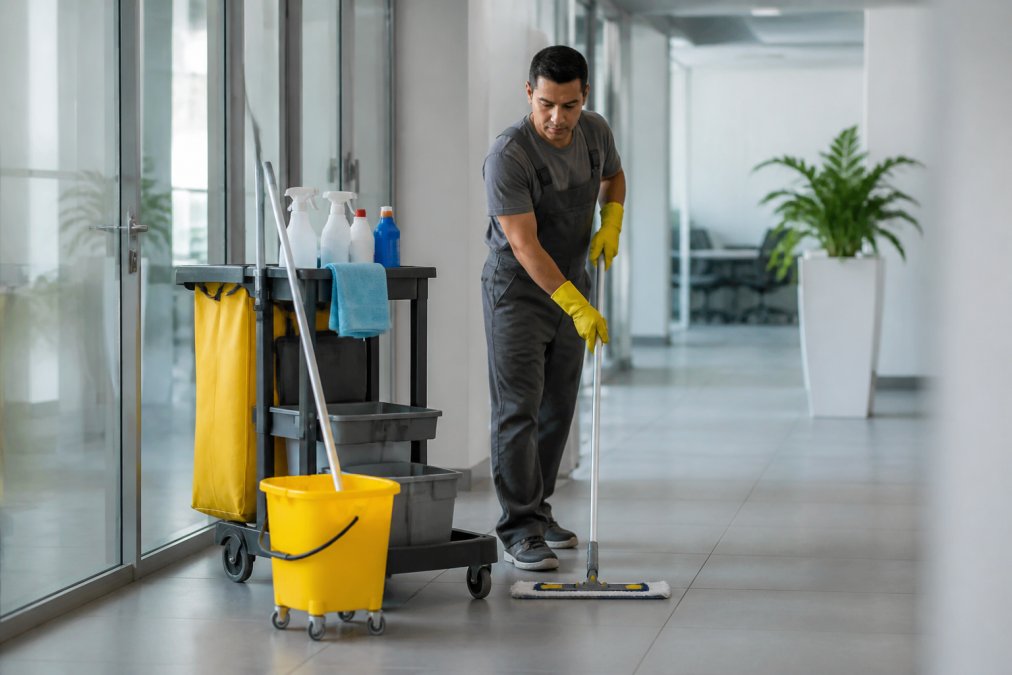
A well-organized cart is not just efficient, it is a safety control. Look for:
- Locked or latched chemical storage so supplies cannot tip or be accessed by others
- A dedicated mop bucket with a wringer, and a separate bucket for restrooms to prevent cross-contamination
- Color-coded microfiber (commonly red for restrooms, blue for general surfaces, green for food areas) so cloths are not cross-used
- A wet floor sign stored on the cart, not in a closet
- A spill kit with absorbent material and a small SDS reference
Green Chemistry and Sustainability Vetting
This is where most hiring guides stop short. Facilities increasingly specify third-party certified green cleaning products, look for the EPA Safer Choice label or Green Seal certification on products a candidate has used. Ask:
- Have you worked with EPA Safer Choice or Green Seal certified products?
- How do you handle disinfecting when a client wants a greener product? (The honest answer: some disinfectants are regulated as pesticides and are not eligible for Safer Choice, so the conversation is about dwell time and targeted use, not swapping the bottle.)
- What do you do with leftover chemical, empty containers, and batteries from equipment?
Training and Documentation
Once hired, the training record matters as much as the training:
- Document the date, topic, and trainer for every chemical the janitor handles
- Keep SDS access current, paper binder or digital, but reachable in under a minute
- Re-train annually and any time a new product is introduced
- Require a signed acknowledgment for each training session
Physical Safety Beyond Chemicals
Chemical handling is only part of the safety picture. Janitors also face:
- Slip and fall risk from wet floors and polished surfaces
- Repetitive strain from mopping, vacuuming, and buffing
- Lifting injuries from moving furniture, trash, and supply cases
- Electrical hazards from wet hands near outlets and equipment
Cultural Fit, Communication, and Retention
Retention starts at hiring: janitors who fit your building's culture and communicate well stay longer, saving you the cost of constant rehiring.
Look for these traits:
- Comfort speaking with tenants and staff
- Willingness to report problems instead of hiding them
- Pride in the appearance of their work area
- Flexibility when schedules or priorities shift
| What to Look For | Why It Matters | How to Check |
|---|---|---|
| Reliability | Predicts attendance and tenure | Reference calls, work history |
| Attention to detail | Drives surface sanitation quality | Scenario questions |
| Background screening | Protects building security | Criminal check, drug test |
| Safety knowledge | Prevents chemical accidents | MSDS and PPE questions |
| Communication skills | Improves retention and tenant trust | In-person interview |
Frequently Asked Questions
What are the key qualities of a good custodian?
Reliability, attention to detail, and a strong work ethic top the list. A good custodian shows up on time, follows cleaning protocols for surface sanitation and waste disposal, and notices small issues before they become complaints. Physical stamina matters too, since floor care and minor repairs demand steady effort. Communication skills and professionalism round out the profile, especially in facilities where staff interact with tenants or visitors daily.
What questions should I ask before hiring a janitorial service?
Ask how they screen workers, what commercial cleaning performance standards they follow, and whether they carry licensing, bonding, and insurance. Request details on their service level agreement, how they handle missed cleanings, and whether they offer month-to-month terms or lock you into a long contract. Also ask who your single point of contact will be and how quickly they respond to emergency requests, since accountability matters as much as cleaning quality.
How do I evaluate the performance of a commercial cleaning crew?
Set measurable benchmarks tied to your service level agreement: restroom sanitation frequency, floor care schedules, waste disposal timing, and supply restocking. Walk the building regularly and log issues with photos and dates. Track complaint volume month over month and review it with your vendor during scheduled check-ins. A crew that welcomes feedback and corrects problems quickly is worth keeping; one that makes excuses after repeated misses is not.
Do janitors need background checks and drug testing?
Most commercial clients expect them. Janitor background check requirements typically include criminal history screening, identity verification, and sometimes drug testing, since custodial staff often work after hours with access to secure areas. Ask any provider to confirm their screening process in writing before signing. Facilities handling healthcare, retail, or sensitive documents should treat screening as non-negotiable, and it should be documented in the service agreement.
Hiring the right janitor takes time, and the cost of a bad hire shows up fast in complaints, turnover, and missed cleanings. CBS Facility Maintenance handles this for you, with vetted staff, a single point of contact, and a month-to-month service model that keeps us accountable. We are fully licensed, bonded, and insured, and new customer first service can start as soon as tomorrow. Get a free quote from CBS Facility Maintenance and stop managing janitorial hiring yourself.