 Ultimate guide
What Do Janitorial Quality Assurance Standards Require?
Last Updated: November 1, 2026
Quick Summary
Janitorial quality assurance standards are written rules that define what clean means in a building, how results get measured, and what happens when a crew misses the mark. They typically cover four layers: cleaning procedures and SOPs, cleaning standards, cleaning checklists, and cleaning audits and inspections that verify work against the standard.
- Separate the inspector from the crew supervisor, because a supervisor who grades their own crew's work will pass it.
- Score each checklist item pass/fail against written acceptance criteria and record location, item, severity, and photograph.
- A common pass threshold is 90, and a score below 85 for two consecutive months triggers a formal corrective-action plan.
- Track first-pass yield as the single best indicator of whether the crew understands the standard.
- A deficiency is resolved only when the reinspection passes, not when the crew says it is fixed.
Table of Contents
- What Janitorial Service Quality Assurance Standards Actually Cover
- How to Build a Janitorial Cleaning Inspection Checklist That Works
- Running a Commercial Cleaning Quality Audit From Start to Finish
- Janitorial Service Performance Metrics That Show Real Consistency
- Setting Up a Cleaning Audit System With Corrective Action
- Training Crews and Standardizing Work Across Shifts
- Putting These Standards to Work in Your Building
- Frequently Asked Questions
What Janitorial Service Quality Assurance Standards Actually Cover
Janitorial service quality assurance standards are the written rules that define what "clean" means in a specific building, how that result gets measured, and what happens when a crew misses the mark.
Most facilities managers learn this the hard way. A vendor starts strong, then drifts. Without measurable janitorial quality assurance, nobody can prove the drift happened until complaints pile up.
The standards themselves typically fall into four layers:
- Cleaning procedures and standard operating procedures (SOPs) that spell out exactly how each task is performed
- Cleaning standards that define the acceptable end state for each surface and space
- Cleaning checklists that translate standards into room-by-room tasks
- Cleaning audits and inspection routines that verify the work against the standard
Miss any layer and the system collapses. SOPs without audits are wishes. Audits without written standards are arguments.
How to Build a Janitorial Cleaning Inspection Checklist That Works
A usable janitorial cleaning inspection checklist starts from your standards, not from a generic template downloaded off the internet. Build it in this order:
- List every space type in the building: restrooms, lobbies, break rooms, offices, stairwells, loading docks.
- For each space, write the visual acceptance criteria in plain language: "no visible dust on horizontal surfaces above 1.8 meters," "no streaks on glass at eye level."
- Assign task frequency to each item: daily, weekly, monthly, quarterly.
- Add a scoring column, typically pass/fail or a 1-5 scale, so results become data.
- Group items by cleaning zone so an inspector can complete a floor in one pass.
The checklist should be short enough that an inspector actually finishes it. A 200-line form gets filled in from memory by week three.
Room-by-Room Items Most Checklists Miss
Restroom standards get plenty of attention. These items usually don't:
- Behind and under fixtures: toilets and urinals anchored to the floor hide grime at the base
- High dusting above sight lines: vent grilles, light diffusers, tops of door frames
- High-touch surfaces between deep cleans: light switches, handrails, elevator buttons
Running a Commercial Cleaning Quality Audit From Start to Finish
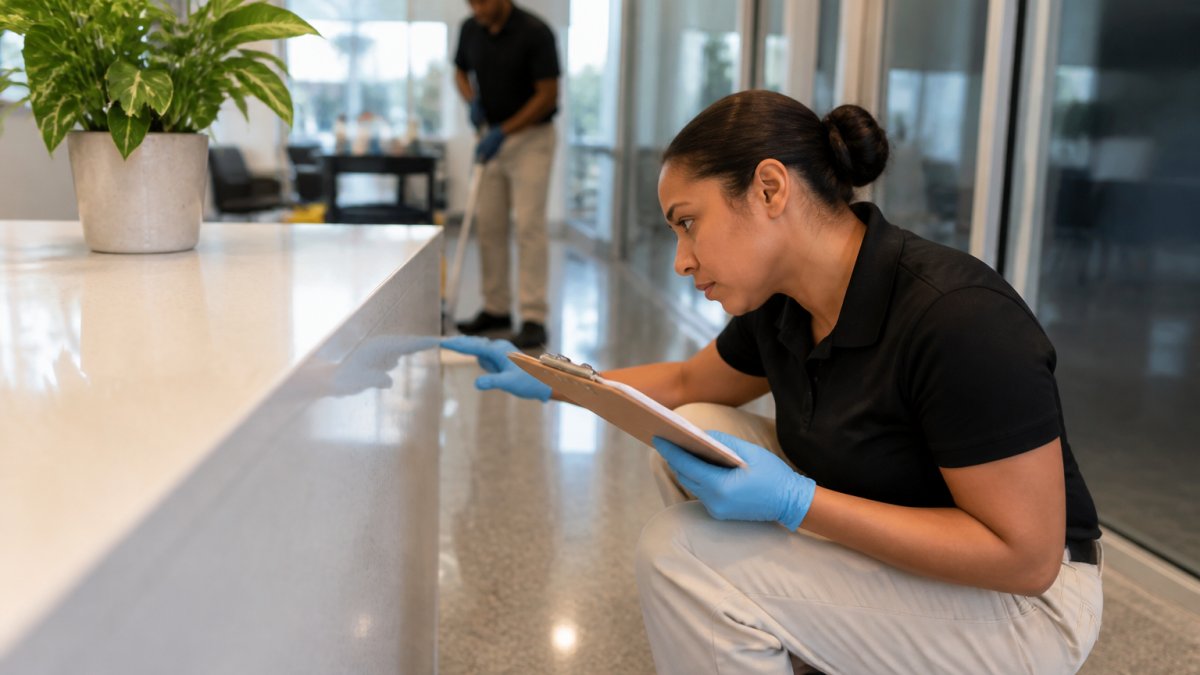
A commercial cleaning quality audit is a scheduled, scored inspection of completed work against your written standards, followed by documented corrective action. Run it the same way every time or the results mean nothing.

Who Inspects and How Often
Separate the inspector from the crew supervisor. A supervisor who grades their own crew's work will pass it. Common structures:
- Dedicated quality inspector for larger accounts, auditing daily or several times a week.
- Account manager as inspector for mid-size accounts, auditing weekly with a rotating sample.
- Client walk-through monthly, using the same checklist, to confirm the score reflects what the client sees.
Audit after the shift completes but before occupants arrive, so the inspection reflects finished work rather than work in progress. Keep the audit time consistent; a 6 a.m. audit and a 2 p.m. audit of the same space will not produce comparable scores.
Sampling: How Much to Inspect
Inspecting everything is unaffordable and inspecting nothing is theater. Use a fixed sampling rule and rotate the sample so every area is covered over a defined cycle:
- Restrooms: inspect a fixed percentage of fixtures and surfaces in each restroom, and rotate which restrooms are sampled each week so all are covered monthly.
- Workstations and offices: sample a set number of workstations per floor rather than every desk.
- Floors and common areas: inspect one full floor rotation per week, plus all high-traffic public areas every audit.
Document the sampling rule in the program. If the sample changes, the score changes, and month-over-month comparisons become meaningless.
Scoring, Severity, and Documentation
Score each checklist item pass/fail against the written acceptance criteria. Record every failure with four fields: location, item, severity, and photograph. Severity tiers keep the score honest:
- Critical: health, safety, or client-visible in a public area. Cap the category score and require same-day correction.
- Major: recurring or in a high-touch zone. Correct within 24 hours.
- Minor: cosmetic or back-of-house. Correct by the next scheduled service.
Photograph deficiencies so the crew sees exactly what failed. A timestamped photo is also the evidence trail if a client disputes the score.
Reinspection and Closure
A deficiency is not resolved when the crew says it is fixed; it is resolved when the reinspection passes. Set the window in the program, commonly 24 hours for major findings and 48 hours for minor ones, with critical findings corrected the same day. The reinspection is a scored event, not a phone call: the inspector returns, checks the specific item, and logs pass or fail.
Root-Cause Analysis and Corrective/Preventive Action
When a deficiency repeats, stop treating it as a cleaning failure and find the cause. A short root-cause review distinguishes the usual suspects:
- Training gap: the crew does not know the standard. Fix with retraining on the specific checklist item.
- Staffing gap: the zone is under-covered or turnover is high. Fix with coverage or cross-training.
- Supply gap: the right chemical or tool is missing. Fix with par-level stocking.
Each corrective action should get an owner and a deadline, and the next audit should verify it. Recurring findings that survive two corrective cycles should escalate to the account manager and the client, with a written plan.
The ISSA cleaning industry standards and certification guidance is a useful reference for structuring inspection criteria and cleaning procedures.
Janitorial Service Performance Metrics That Show Real Consistency
Most janitorial quality assurance programs track the same six metrics. The difference between a program that works and one that produces paperwork is whether each metric has a threshold, a scoring rule, and a consequence. A metric without a threshold is a number nobody acts on.
A Measurable Quality-Assurance Scorecard
Build the scorecard around four weighted categories. The weights below are a common starting point; adjust them to the building's use and client priorities, but write the weights into the contract so they cannot drift.
| Category | Weight | What It Captures |
|---|---|---|
| Appearance and cleanliness | 40% | Visible dust, soil, streaks, trash, restroom condition |
| Task completion | 25% | Scheduled daily and periodic tasks verified as done |
| Response and resolution | 20% | Complaint response time and reinspection closure |
| Client satisfaction | 15% | Survey score and escalated complaints |
Each category scores 0-100. The weighted total is the monthly quality score. A common pass threshold is 90; a score below 85 for two consecutive months typically triggers a formal corrective-action plan.
Scoring Rules That Make the Number Mean Something
A score is only useful if two inspectors would grade the same room the same way. Define the rules before the first audit:
- Pass/fail per item, not per room. A restroom with one missed mirror is not a failed restroom; it is one failed item out of, say, 18. Room scores are the percentage of items passed.
- Severity tiers. Classify each deficiency as critical (health, safety, or client-visible in a public area), major (recurring or in a high-touch zone), or minor (cosmetic, back-of-house). Critical findings cap the category score regardless of other passes.
- Defect density. Report deficiencies per 1,000 square feet inspected. This normalizes scores across a small suite and a full floor, so month-over-month comparisons are honest.
Thresholds and Corrective-Action Triggers
Write the triggers into the program so nobody argues about them after a bad month:
| Metric | Target | Warning | Corrective Action |
|---|---|---|---|
| Weighted quality score | 90+ | 85-89 | Below 85, or below 90 two months running |
| First-pass yield | 95%+ | 90-94% | Below 90% |
| Critical deficiencies | 0 | 1 per audit | Any critical finding |
| Reinspection closure | 100% within 48 hours | 90-99% | Below 90% or any open item past 72 hours |
| Complaint response | Under 4 hours | 4-8 hours | Over 8 hours or repeat complaint |
| On-time service | 98%+ | 95-97% | Below 95% |
These are starting thresholds, not universal law. A healthcare or food-service environment should tighten critical-deficiency and response targets; a low-traffic office may relax cosmetic tolerances. The point is that the number is agreed, visible, and tied to an action.
Reading the Trend, Not the Week
One strong audit means little. Plot the weighted score and first-pass yield by month and by zone. A pass rate that holds steady month over month is the real signal of janitorial quality assurance working. A score that swings 15 points between audits usually points to inspector inconsistency or sampling error, not crew performance, check the sampling method before writing a corrective action.
If you are comparing how to staff and manage this measurement system, our guide to outsourcing facility maintenance versus in-house breaks down the trade-offs.
Setting Up a Cleaning Audit System With Corrective Action
A cleaning audit system is the structure that connects inspection results to fixes: who reviews the score, who owns the correction, and how recurrence gets prevented. Without that structure, audits become paperwork.
Build it around three roles: the inspector who scores, the supervisor who assigns corrections, and the account manager who reviews trends with the client. Every deficiency gets a corrective action with an owner and a deadline. Recurring deficiencies trigger root-cause analysis: was it a training gap, a scheduling problem, or a supply issue?
If you're weighing how to staff and manage this system, our guide to outsourcing facility maintenance versus in-house breaks down the trade-offs.
Training Crews and Standardizing Work Across Shifts
Consistency across shifts comes from standardization, not from hoping every crew leader runs things the same way. For the staffing model that keeps quality consistent across shifts, see day porter services. Training on the written SOPs, then verifying with audits, is the only reliable path.
What works in practice:
- Train new hires on the checklist they'll actually be audited against
- Cross-train crews so any shift can cover any zone
- Post standards in janitor closets where the work happens
Putting These Standards to Work in Your Building
Standards only pay off when someone owns them end to end.
CBS Facility Maintenance offers a single point of contact for managing your facility services, and operates on a month-to-month basis with no long-term contracts.
You can see what janitorial services we provide, read why clients switch to us, or ask us anything about setting up an audit system for your property.
Frequently Asked Questions
What are janitorial service quality assurance standards?
They are the written rules a cleaning provider uses to define acceptable work and prove it was done. A complete set covers cleaning procedures and standard operating procedures, room-specific checklists, inspection frequency, scoring thresholds, and a corrective action process for deficiencies. Standards also name who inspects, what gets sampled, and how results reach the client. Without written standards, quality depends on whoever shows up that night, which is why consistency problems appear months into a contract.
How do you measure the quality of a janitorial service?
Score inspected areas against a checklist and convert the results into janitorial service performance metrics. Common measures include inspection pass rate, number of cleaning deficiencies per audit, average response time on spill response and incident response, on-time service percentage, and client satisfaction scores from periodic feedback. Track these over months, not weeks, so you can see whether consistency holds. A provider that shares audit results openly is easier to hold accountable than one that only reports when something goes wrong.
What should a janitorial cleaning inspection checklist include?
Build it room by room, not task by task. Restroom standards should list toilets and urinals, dispensers, mirrors, and high-touch surfaces. Office areas need surface dusting, trash removal, floor care, and spot checks for dust, dirt, and spills. Add hard-floor care and carpet extraction schedules, breakroom sanitation, and entryway glass. Each line should be pass or fail with a photo option, so two inspectors looking at the same stall reach the same conclusion.
How often should a commercial cleaning service be inspected?
Most facilities need a weekly walkthrough of high-traffic zones and a full monthly audit covering every area on the checklist. Restrooms and lobbies justify more frequent checks because visual cleanliness there shapes client impressions fastest. Add a quarterly deep review that includes client feedback and a reinspection of any area that failed the prior audit. Frequency should follow risk: a healthcare suite or food service area warrants tighter intervals than a low-traffic office floor.
What is the difference between quality assurance and quality control in cleaning?
Quality assurance is the system built before work starts: written cleaning procedures, training, task frequency schedules, and defined cleaning standards. Quality control is the checking that happens after, such as inspections and cleaning audits that catch deficiencies. Assurance prevents problems; control finds the ones that slipped through. A provider with strong assurance but no control cannot prove results, and one with control but no assurance spends every audit fixing the same recurring failures.
How do you create a cleaning audit system that actually gets used?
Start with a checklist tied to your cleaning standards, then set a fixed inspection schedule and a scoring scale, for example 90 percent or higher as acceptable. Assign one accountable inspector per building. Log every deficiency with a photo and a due date, and require a reinspection before closing it. Review audit results monthly with the crew and the client. Digital tools help here because they timestamp inspections and generate reports automatically instead of leaving paper forms in a closet.
The gap between a clean building and a provably clean building is documentation. If your current vendor can't show you audit scores, closure rates, and a written standard, you're managing on trust alone. Get started with CBS Facility Maintenance and put measurable janitorial quality assurance to work in your facility.