 Ultimate guide
Commercial Property Maintenance for Small Offices: A Guide
Quick Summary
Commercial property maintenance is the set of recurring and reactive tasks that keep a small office building safe, functional, and presentable, including heating and cooling, electrical and plumbing systems, cleaning, exterior upkeep, and repairs. Many small offices fail not from lack of effort but from unclear responsibility, so the lease should define who handles each task.
- Building systems like HVAC, electrical, and plumbing drive most emergency maintenance calls.
- HVAC filters need changing every one to three months, with a professional inspection at least yearly.
- Walk the building perimeter quarterly to catch cracks, drainage problems, and sealant failures.
- Budget separately for recurring services, planned repairs, and emergency reserves.
- Ask every provider to price the same scope before comparing quotes.
Table of Contents
- What Commercial Property Maintenance Covers in a Small Office
- Small Office Maintenance Checklist by System
- Building a Commercial Building Maintenance Schedule
- What Commercial Property Maintenance for Small Offices Costs
- In-House Tasks vs. Outsourcing: A Decision Matrix
- How to Choose the Best Commercial Property Maintenance for Small Offices
- Booking Your Maintenance Plan with CBS Facility Maintenance
- Frequently Asked Questions
What Commercial Property Maintenance Covers in a Small Office
Last Updated: November 9, 2026
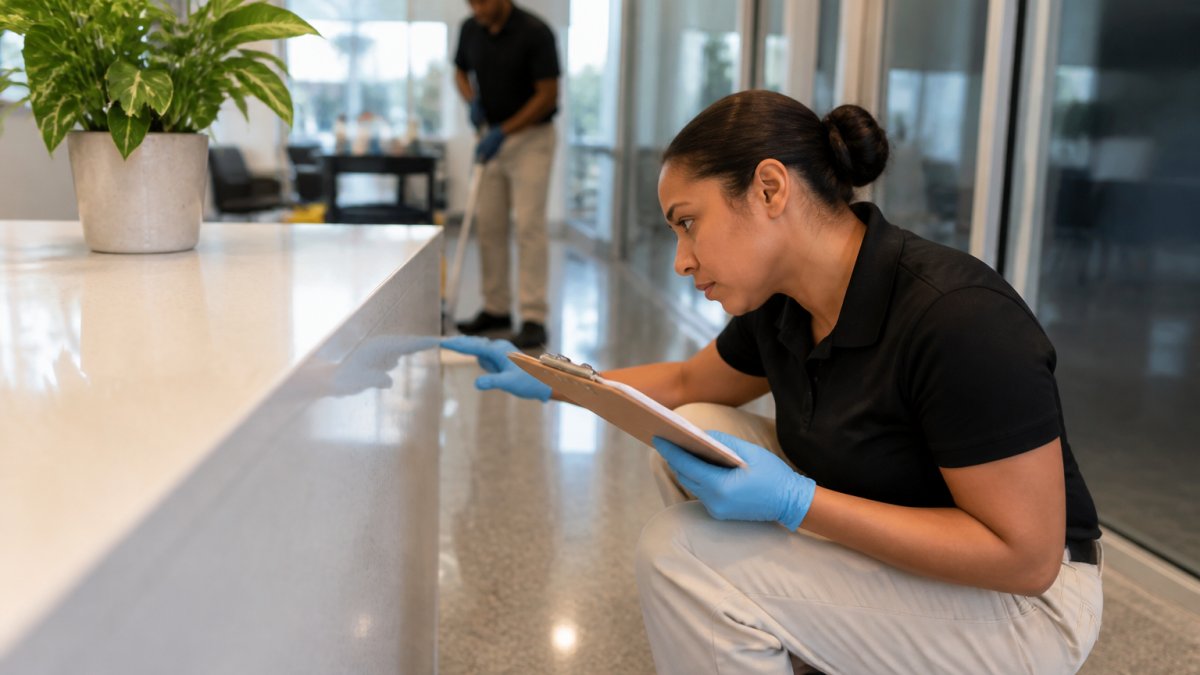
Small offices carry the same maintenance obligations as large commercial buildings, but with a fraction of the staff to handle them. Commercial property maintenance is the set of recurring and reactive tasks that keep a building safe, functional, and presentable: heating and cooling, electrical and plumbing systems, cleaning, exterior upkeep, and repairs. Most small offices don't have a maintenance problem so much as a coverage problem. Someone assumes the landlord handles the roof, the office manager assumes the janitor covers the restrooms, and the parking lot cracks while everyone is looking elsewhere.
The core areas are predictable. Building systems (HVAC, electrical, plumbing) drive the majority of emergency calls. Janitorial and sanitation work affects employee health and perception. Exterior and structural items, including parking lots, walkways, signage, and the building envelope, degrade slowly and then suddenly. Some of these tasks belong to the landlord under a lease, and others fall to the tenant. Knowing which is which before something fails is the single most useful step a small office manager can take.
Watch out: many small offices assume a lease covers all repairs. Read the maintenance clauses for the specific division of responsibility before you assume the landlord will fund a fix.
Small Office Maintenance Checklist by System
Work through this checklist by system rather than by room. Systems fail in predictable ways, and grouping tasks this way makes it easier to assign responsibility and track completion.
HVAC, Electrical and Plumbing Checks
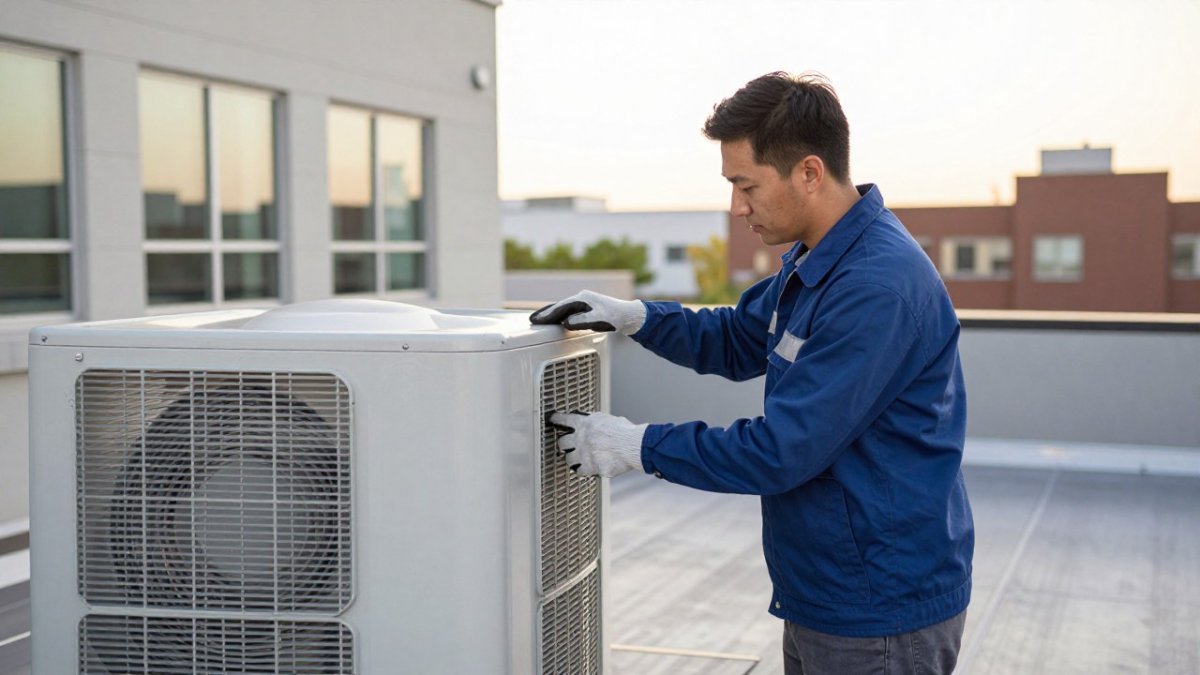
Heating, ventilation, and air conditioning units need filter changes every one to three months and a professional inspection at least once a year. Electrical panels should be checked for warm breakers, scorch marks, and labeling accuracy. Plumbing checks focus on slow drains, water pressure changes, and any signs of leaks under sinks or behind restroom walls. Small offices often skip these until a unit fails in July, so schedule them in the off-season.
Exterior, Parking and Structural Items
Walk the perimeter quarterly. Look for cracks in pavement, drainage problems that pool water near the foundation, loose signage, damaged gutters, and sealant failure around windows and doors. Parking lots need restriping and crack sealing on a regular cycle, since deferred repairs tend to multiply costs. Structural items such as stairs, railings, and handicap ramps are safety-critical and should be inspected on a fixed schedule.
Building a Commercial Building Maintenance Schedule
A commercial building maintenance schedule turns the checklist into a calendar. Assign each task a frequency (daily, weekly, monthly, quarterly, annually), a responsible party (tenant, landlord, or outside vendor), and a record of completion. Keep it to one shared document that the office manager can update, and review it each quarter to catch tasks that were missed.
A practical starting structure:
- Monthly: HVAC filter check, fire extinguisher visual inspection, restroom supply restock
- Quarterly: Exterior walkthrough, gutter and drain clearing, electrical panel visual inspection
- Annually: Professional HVAC service, backflow testing where required, roof inspection, parking lot assessment
The schedule is only as good as the follow-through, so assign one person to own it.
What Commercial Property Maintenance for Small Offices Costs
Costs vary widely with building age, square footage, lease terms, and how much work is outsourced, so no single figure applies.
Recurring contracted services are the most predictable.
Planned repairs cover items you know will fail on a cycle: parking lot crack sealing and restriping, exterior sealant renewal, backflow testing where required, and roof inspections. These are not emergencies, but deferring them multiplies cost.
Emergency reserves cover the failures you cannot schedule: a failed HVAC compressor in July, a burst supply line, a broken storefront glass. A practical target is one to three months of your recurring maintenance spend held in reserve, reviewed annually.
Several cost drivers move the number more than others. Building age matters most: systems in the last third of their service life generate more reactive calls. Square footage affects janitorial and HVAC pricing directly.
Watch out: a low monthly bid that excludes after-hours emergency response, restroom supplies, or exterior work is not comparable to a bundled quote. Ask every provider to price the same scope before you compare numbers.
For a current, property-specific quote, contact CBS Facility Maintenance directly.
In-House Tasks vs. Outsourcing: A Decision Matrix
Some maintenance work is reasonable to handle internally, while other work demands a licensed professional. Use this matrix to decide:
| Task | Handle In-House | Outsource | Reason |
|---|---|---|---|
| Replacing HVAC filters | Yes | No | Simple, frequent, low risk |
| Restocking supplies | Yes | No | Routine, no specialist needed |
| Routine janitorial cleaning | Depends on staff time | Usually yes | Consistency and time savings |
| Electrical repairs | No | Yes | Licensing and safety requirements |
| HVAC servicing | No | Yes | Requires certified technicians |
| Plumbing repairs | No | Yes | Code compliance and water damage risk |
| Parking lot and exterior work | No | Yes | Specialized equipment and labor |
The general rule: keep frequent, low-skill tasks in-house, and outsource anything involving licensed trades, specialized equipment, or code compliance.
How to Choose the Best Commercial Property Maintenance for Small Offices
Choosing a provider is less about finding the cheapest bid and more about finding one who will show up consistently and whose scope matches your lease obligations. Small offices have less staff time to manage a vendor, so the vetting process should screen for providers who reduce coordination work rather than add to it. Evaluate candidates on these points, and ask for documentation rather than verbal assurances.
-
Licensing, bonding, and insurance. Confirm the provider is licensed for the trades it performs, bonded where required, and insured. Ask for a certificate of insurance (COI) naming your business as an additional insured, and verify the general liability and workers' compensation limits are current. A provider who cannot produce a COI promptly is a coordination risk, not just a compliance one.
-
Scope of services and lease alignment. Map the proposed scope against your lease's maintenance clauses before you sign. A single provider covering janitorial, repairs, and exterior work reduces coordination overhead, but only if the scope does not duplicate work the landlord already funds. Ask the provider to identify which tasks in their proposal are landlord responsibilities under a typical lease so you can flag overlaps.
-
Single point of contact and escalation path. Know exactly who to call when something breaks at 4 p.m. on a Friday, and ask what happens if that person is unavailable. A named account manager plus a documented escalation path is more useful than a general dispatch number.
-
Service-level terms in writing. Ask for response-time commitments for routine and emergency calls, including after-hours and weekend coverage. Vague promises are common; written service levels with remedies for missed response times are not. This is where small offices gain the most leverage, because a provider who will not commit in writing is telling you something.
-
Contract terms and exit provisions. Month-to-month arrangements let you leave if service slips. Long lock-in contracts make that harder, and auto-renewal clauses are easy to miss. Read the termination and renewal language before signing, and ask for the notice period in writing.
-
Scope-creep controls. Ask how the provider handles work outside the agreed scope, whether it requires a written change order, who approves it, and how it is priced. Small offices often absorb unplanned add-on charges because no one defined the boundary in advance.
-
References from similar buildings. Ask for examples of clients with similar building types and square footage. A provider experienced with large facilities may not be priced or staffed for a small office, and vice versa.
Be wary of providers who won't put service expectations in writing. A clear scope, a COI, and a written response commitment protect you far more than a low hourly rate.
CBS Facility Maintenance is a family-owned provider with more than 20 years of experience, offering janitorial, repair, and landscape services under one point of contact, with month-to-month terms. Still, compare providers on the criteria above, and request a written scope and COI before you commit.
Booking Your Maintenance Plan with CBS Facility Maintenance
If you want to replace a patchwork of vendors with one accountable team, request a quote from CBS Facility Maintenance to talk through your building's systems, schedule, and budget. Our team is fully licensed, bonded, and insured, and we offer a first service visit as soon as tomorrow for new customers.
Frequently Asked Questions
What is a good maintenance schedule for commercial buildings?
A practical schedule separates daily, weekly, monthly, quarterly and annual tasks. Daily items usually include restroom checks and trash removal. Weekly items cover floor cleaning and walkthroughs of common areas. Monthly work includes filter changes and light fixture checks. Quarterly and annual tasks cover HVAC servicing, roof inspection, backflow testing and fire system checks. Match the frequency to your equipment manuals and local code requirements, and log each completed task so the record is available for inspections and insurance reviews.
How much does commercial property maintenance cost for a small office?
Cost depends on square footage, how many systems need service, how often visits occur, and whether emergency response is included. Because pricing varies with those factors, the most accurate figure comes from a site assessment and written quote. Ask any provider to itemize recurring services separately from repairs, and confirm whether materials, after-hours calls and supplies are included. For current pricing specific to your office, request a quote from CBS Facility Maintenance.
Which maintenance tasks should a small office handle in-house?
Routine tasks that need little training, such as replacing air filters, emptying trash, checking restroom supplies, and reporting broken fixtures, are often handled by office staff or a designated employee. Work involving high-voltage electrical, refrigerant, roofing, fire suppression or structural repairs should go to licensed and insured contractors. Keeping a clear list of in-house versus outsourced tasks prevents gaps where neither party takes responsibility.
When should a small office hire a commercial maintenance provider?
Consider hiring a provider when internal staff cannot keep up with routine upkeep, when several vendors are needed for cleaning, repairs and landscaping, or when repeated issues go unresolved. Outsourcing is also worth evaluating when a building has specialized systems that require licensed technicians. A single point of contact can reduce coordination time, and a provider that is fully licensed, bonded and insured limits your liability for on-site work.
Are office buildings considered commercial property?
Yes. Office buildings are classified as commercial property, and they are generally subject to commercial building codes, fire safety rules and accessibility standards rather than residential rules. Maintenance obligations are set by your lease or ownership documents as well as applicable local codes. Confirm with your property manager or attorney which party is responsible for each system before you assign tasks.
What comes under office maintenance?
Office maintenance generally includes HVAC servicing, electrical and lighting checks, plumbing and restroom upkeep, janitorial cleaning, exterior and parking lot care, and minor repairs to walls, doors and fixtures. Some offices also include landscaping, pest control and life-safety system testing. Written scope documents help both sides agree on which tasks are recurring and which are billed as one-time projects.
What are the 3 P's of maintenance?
The three P's are usually listed as preventive, predictive and preventative-corrective approaches. Preventive maintenance follows a fixed schedule, such as filter changes every quarter. Predictive maintenance uses condition data, like temperature or vibration readings, to time repairs before failure. Corrective work fixes problems after they appear. Small offices benefit most from a preventive base with predictive checks on high-cost equipment such as HVAC units.
How do I vet a commercial maintenance provider?
Ask for proof of licensing, bonding and general liability insurance, then confirm each certificate is current. Request references from similar facilities, and ask how emergency calls are handled and who your single point of contact will be. Review the service terms carefully, including whether the agreement is month-to-month or locked into a long-term contract, and how quality is checked after each visit.