 How-to
Customizing Commercial Cleaning Schedules for Offices
Table of Contents
- Start With a Walkthrough: Audit Your Space Before You Schedule
- Build Your Office Cleaning Checklist Daily Weekly Monthly
- Know the Commercial Cleaning Frequency Standards That Apply
- Match Cleaning Frequency to Foot Traffic, Occupancy, and Hybrid Schedules
- Put It in Writing: Janitorial Service Scope of Work Template
- Track Results: KPIs That Prove Your Cleaning Schedule Works
- Common Mistakes When Customizing Commercial Cleaning Schedules for Offices
- Frequently Asked Questions
Last Updated: September 27, 2026
Start With a Walkthrough: Audit Your Space Before You Schedule
Customizing commercial cleaning schedules for offices starts with a walkthrough, not a spreadsheet. Before you assign a single task, walk every floor and note what actually needs attention.
This guide from CBS Facility Maintenance covers how to build a schedule that fits your building instead of a generic template. Most offices waste money cleaning spaces nobody uses. A proper audit fixes that fast.
Here's what to record on your walkthrough:
- Square footage by zone (open desks, private offices, conference rooms, break rooms, restrooms)
- High-touch surfaces (door handles, light switches, shared keyboards, elevator buttons)
- Foot traffic patterns (which entrances and hallways get the most use)
- Problem areas (sticky floors, dusty vents, worn carpet, cluttered storage)
- Occupancy rates by day and by floor
The U.S. Environmental Protection Agency's guidance on indoor air quality notes that indoor pollutants often build up in spaces with poor ventilation and heavy occupancy. Your walkthrough should flag those rooms first.
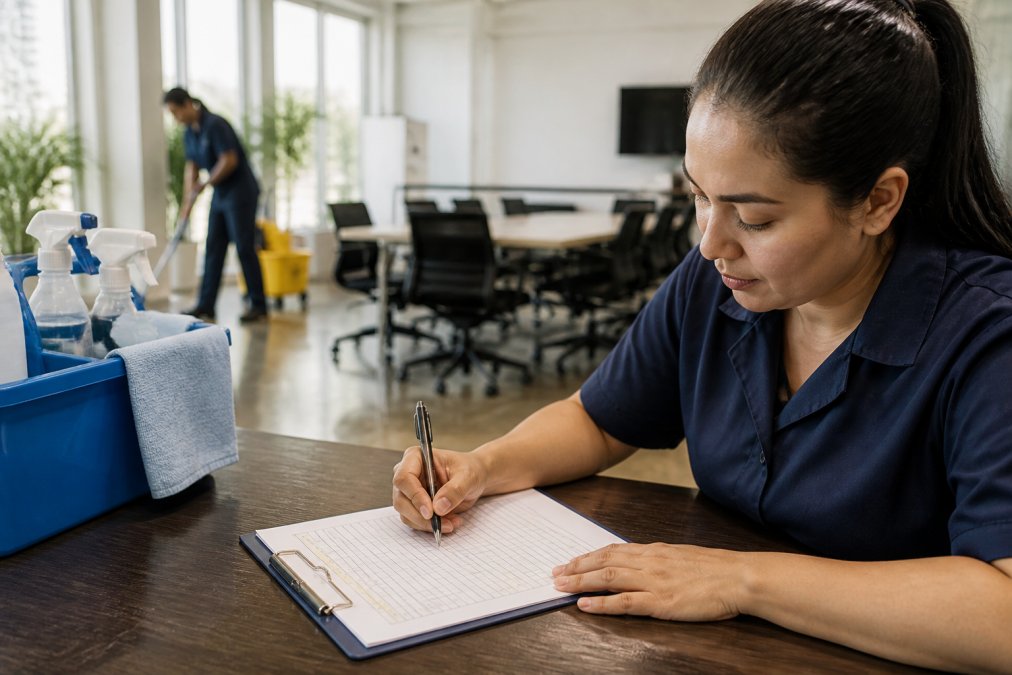
Write down what you see. Photos help. You'll use this list to set cleaning frequency for every zone.
Build Your Office Cleaning Checklist Daily Weekly Monthly
An office cleaning checklist daily weekly monthly breaks tasks into three tiers based on urgency and how fast dirt builds up. Daily items protect health and first impressions. Weekly and monthly items handle the deeper work.

Daily Tasks: What Cannot Wait
Daily cleaning covers anything that affects health, safety, or how the office looks to visitors. Skip these and problems show up within hours.
- Empty trash and replace liners
- Wipe and disinfect high-touch surfaces
- Clean and restock restrooms
- Sweep or vacuum main walkways
- Spot-clean glass doors and entryways
- Wipe break room tables and counters
Weekly and Monthly Tasks: Where Deep Cleaning Fits
Weekly tasks handle buildup that daily work misses. Monthly tasks cover the jobs that need time and equipment.
Weekly:
- Vacuum carpets and rugs in full
- Dust desks, shelves, and ledges
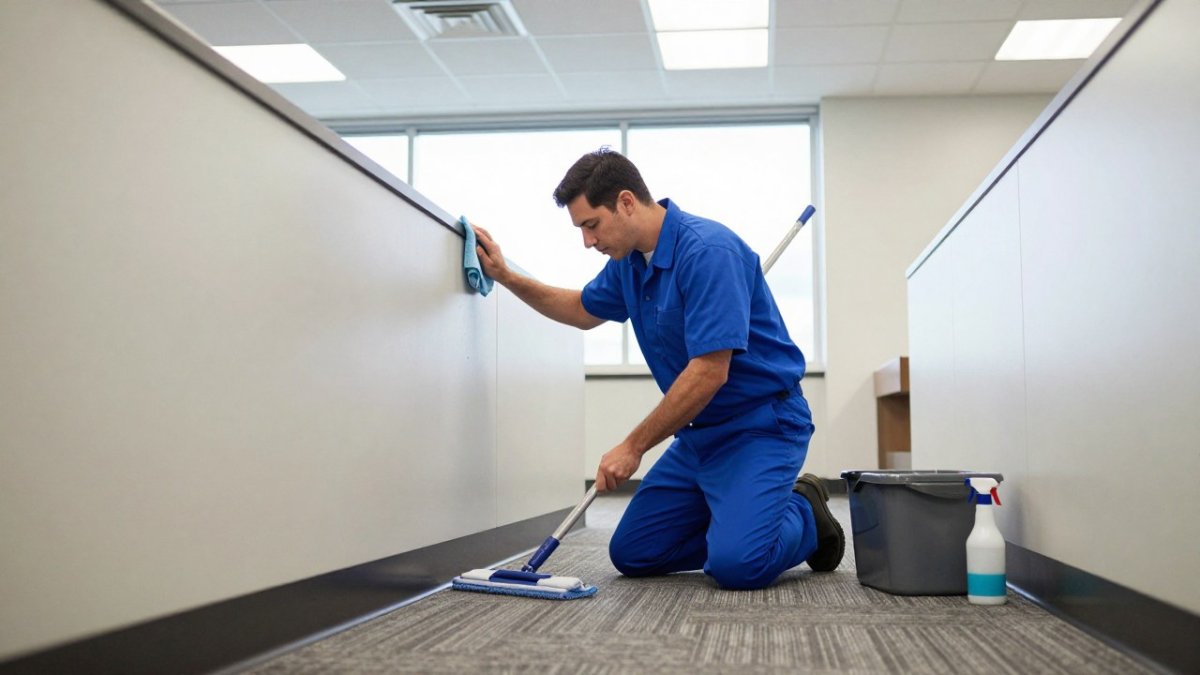
- Mop hard floors
- Clean interior glass and mirrors
- Wipe down chairs and shared furniture
Monthly:
- Deep clean carpets and upholstery
- Clean HVAC vents and returns
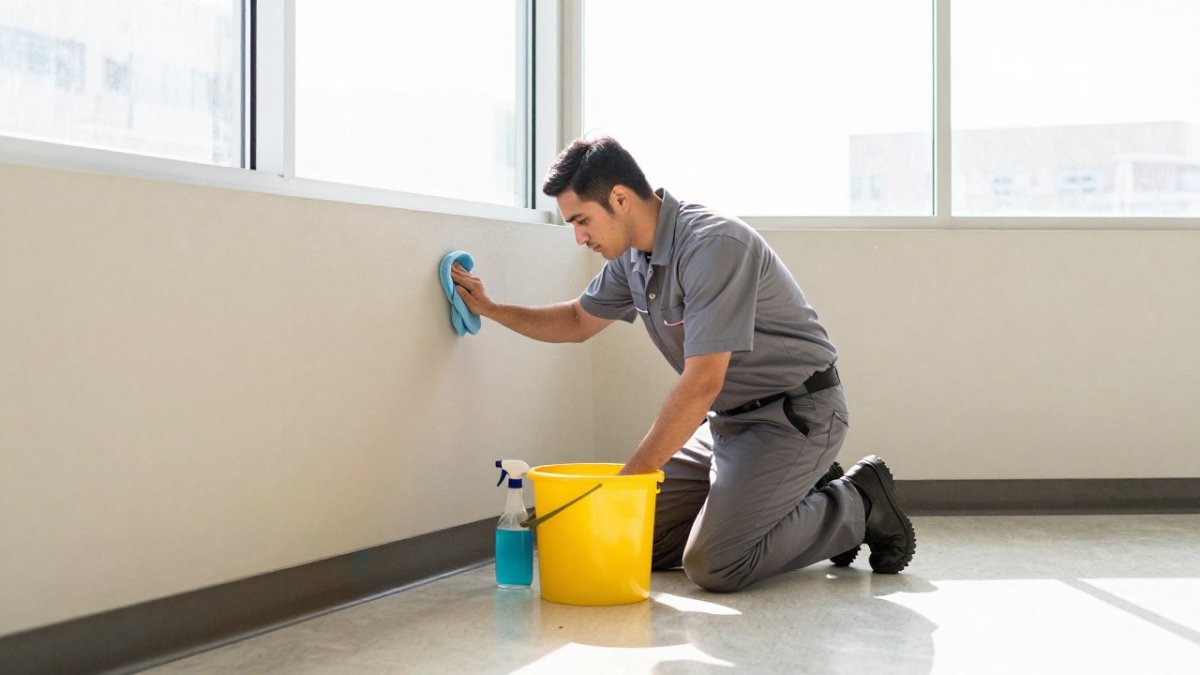
- Scrub baseboards and corners
- Polish hard floors
- Clean inside windows and light fixtures
Know the Commercial Cleaning Frequency Standards That Apply
Commercial cleaning frequency standards are not a single rulebook. They are a stack of overlapping requirements from four sources, and your schedule has to satisfy the strictest one that applies to each space.
The four sources of frequency standards:
- Public health codes. State and local health departments set sanitation requirements for restrooms and food-handling areas. These are enforceable and carry penalties for non-compliance.
- Occupational safety guidance. The Occupational Safety and Health Administration's sanitation requirements for places of employment establishes baseline expectations for restroom cleanliness, potable water, and waste handling in workplaces.
- Building and fire codes. Local fire marshals regulate trash accumulation, exit-path clearance, and storage of cleaning chemicals. These affect how often waste must leave the building, not just how often it's collected.
- Industry and certification standards. Green cleaning certifications, indoor air quality programs, and sector-specific standards (healthcare, childcare, food service) add frequency requirements on top of the legal floor.
How to reconcile them:
| Space Type | Typical Minimum Frequency | Governing Source |
|---|---|---|
| Restrooms | Multiple times daily | Health code, OSHA sanitation |
| Break rooms and kitchens | Daily, plus after meals | Health code (food handling) |
| High-touch surfaces | Daily or more | OSHA sanitation, industry guidance |
| Open work areas | Daily trash, weekly dust | OSHA sanitation, building code |
| Carpets and upholstery | Weekly vacuum, monthly deep clean | Industry standard, IAQ program |
| HVAC vents | Monthly to quarterly | IAQ program, manufacturer spec |
| Trash rooms and dumpsters | Per fire code schedule | Local fire code |
A practical verification step:
Where customization begins:
Match Cleaning Frequency to Foot Traffic, Occupancy, and Hybrid Schedules
Cleaning frequency should track how many people use a space and how often. A lobby with heavy foot traffic needs more attention than a storage room nobody enters.
- Heavy traffic (main entrances, elevators, shared restrooms): clean multiple times daily
- Medium traffic (open desks, hallways): clean daily
- Light traffic (private offices, storage): clean weekly
Hybrid Work Adjustments: When Fewer Desks Are Used
Hybrid schedules change everything. When half the desks sit empty on any given day, cleaning every workstation daily wastes time and money.
Put It in Writing: Janitorial Service Scope of Work Template
A janitorial service scope of work is the contract document that converts your custom schedule into an enforceable agreement. It does three things: it defines every task and its frequency, it assigns responsibility, and it creates a paper trail when something goes wrong.
What a defensible scope must include:
Section 1: Property and Access
- Building address, total square footage, and square footage by zone
- Number of floors, restrooms, break rooms, and entrances
- Operating hours, after-hours access procedure, alarm codes, and key-holder responsibilities
- Any restricted areas (server rooms, executive suites, labs) and their access rules
Section 2: Task Schedule by Zone
- List every task, the zone it applies to, and its frequency (daily, weekly, monthly, quarterly, annual)
- Reference the frequency standards sheet from the previous section so each frequency has a documented basis
- Note any task that is performed only on request
Section 3: Standards and Supplies
- Who provides consumables (paper products, soap, liners) and who pays for them
- Approved cleaning products, including any green cleaning or fragrance-free requirements
- Equipment provided by each party (vacuums, floor machines, carts)
- Chemical storage and safety data sheet (SDS) requirements
Section 4: Quality Control and Reporting
- Inspection frequency and who performs inspections
- How deficiencies are reported, acknowledged, and corrected, including a correction deadline
- Monthly or quarterly performance review meeting
- Complaint intake process and response-time expectation
Section 5: Change Orders and Adjustments
- How either party requests a frequency change, added task, or reduced service
- Notice period required for changes
- How pricing adjusts when scope changes
- Seasonal or event-driven service additions
Section 6: Terms and Termination
- Contract length, renewal terms, and termination notice period
- Insurance and bonding requirements
- Emergency and after-hours service rates
- Dispute resolution process
Why the change-order clause matters most:
A note on green cleaning clauses:
Review cadence:
Track Results: KPIs That Prove Your Cleaning Schedule Works
Key performance indicators (KPIs) show whether your schedule delivers. Without them, you're guessing.
Track these metrics:
- Inspection scores from weekly walkthroughs
- Complaint count per month by category
- Restroom restock frequency (runs out too fast means you underscheduled)
- Task completion rate against the scope of work
- Response time on emergency or repair requests
Common Mistakes When Customizing Commercial Cleaning Schedules for Offices
Other common errors:
- Skipping the walkthrough. You can't schedule what you haven't measured.
- Cleaning empty desks daily. Hybrid work makes this a waste.
- Ignoring high-touch surfaces. These spread germs faster than floors get dirty.
- No written scope. Verbal agreements fall apart when staff changes.
- Never reviewing KPIs. A schedule that never changes stops fitting the building.
- Forgetting preventative maintenance. Small repairs and vent cleaning prevent bigger problems later.
Fix these and your schedule stays accurate as your building changes.
Frequently Asked Questions
What factors should influence a customized office cleaning schedule?
The biggest factors are square footage, occupancy rates, foot traffic patterns, number of restrooms, and whether your office operates on a hybrid schedule. Industry-specific rules matter too: healthcare suites need stricter sanitation protocols than a standard office. A walkthrough audit helps you map high-touch surfaces, shared kitchen areas, and floor types so your cleaning frequency matches actual use, not guesswork.
How often should high-traffic areas be cleaned in an office?
High-touch surfaces like door handles, elevator buttons, shared keyboards, and breakroom counters should be disinfected at least once daily, and twice daily in offices with heavy foot traffic or multiple shifts. Floors in lobbies and corridors typically need daily vacuuming or mopping. Restrooms generally require daily service, often twice daily if occupancy exceeds 50 people per floor. Adjust upward during flu season or when occupancy spikes.
What is the difference between daily, weekly, and monthly office cleaning tasks?
Daily tasks cover trash removal, restroom hygiene, high-touch surface disinfection, and spot floor care. Weekly tasks include vacuuming under furniture, dusting vents and blinds, and deeper restroom scrubbing. Monthly work covers HVAC vent cleaning, upholstery maintenance, carpet extraction, and window washing. Separating tasks this way keeps routine maintenance efficient while ensuring deep cleaning happens on a predictable cycle.
How do you balance budget and cleanliness when customizing a janitorial schedule?
Start by identifying which areas drive complaints or health risks and protect those first. Shift some weekly tasks to biweekly where traffic is low, and consolidate monthly deep cleaning into a single visit. A month-to-month service model gives you flexibility to scale frequency up or down as occupancy changes, so you are not paying for empty-office cleanings during slow periods. Request a quote to compare options.
Building a schedule that fits your office takes real work, and it changes as your space does. CBS Facility Maintenance handles that for you with customized cleaning plans, a single point of contact, and a month-to-month model with no long-term contracts. Our team brings over 20 years of experience across janitorial, repair, and facility services, all under one roof. Get started with CBS Facility Maintenance and build a cleaning schedule that actually matches your building.